APPLY TO ADOPT ZETs
Call for adopting ZETs
NHEV is built and funded on a Hybrid PPP Model called Annuity Hybrid E-Mobility (AHEM); currently in expansion mode of 5500 km e-highways on Bharatmala & Sagarmala routes from Delhi to Kanyakumari via Mumbai and Kolkata corridors. It conducted Tech-Trials on 3 pilot corridors, namely Delhi-Agra (Yamuna Expressway – 2020) and Delhi – Jaipur (NH48 – 2022) , Chennai – Trichy (NH 179 – 2024)
This call for adoption is for the shippers to green their delivery operations through adoption of ZETs under the NHEV initiative. The ZETs shall be provided to the applicants by Transvolt and the appropriate vehicle model will be mapped based on their business operations.
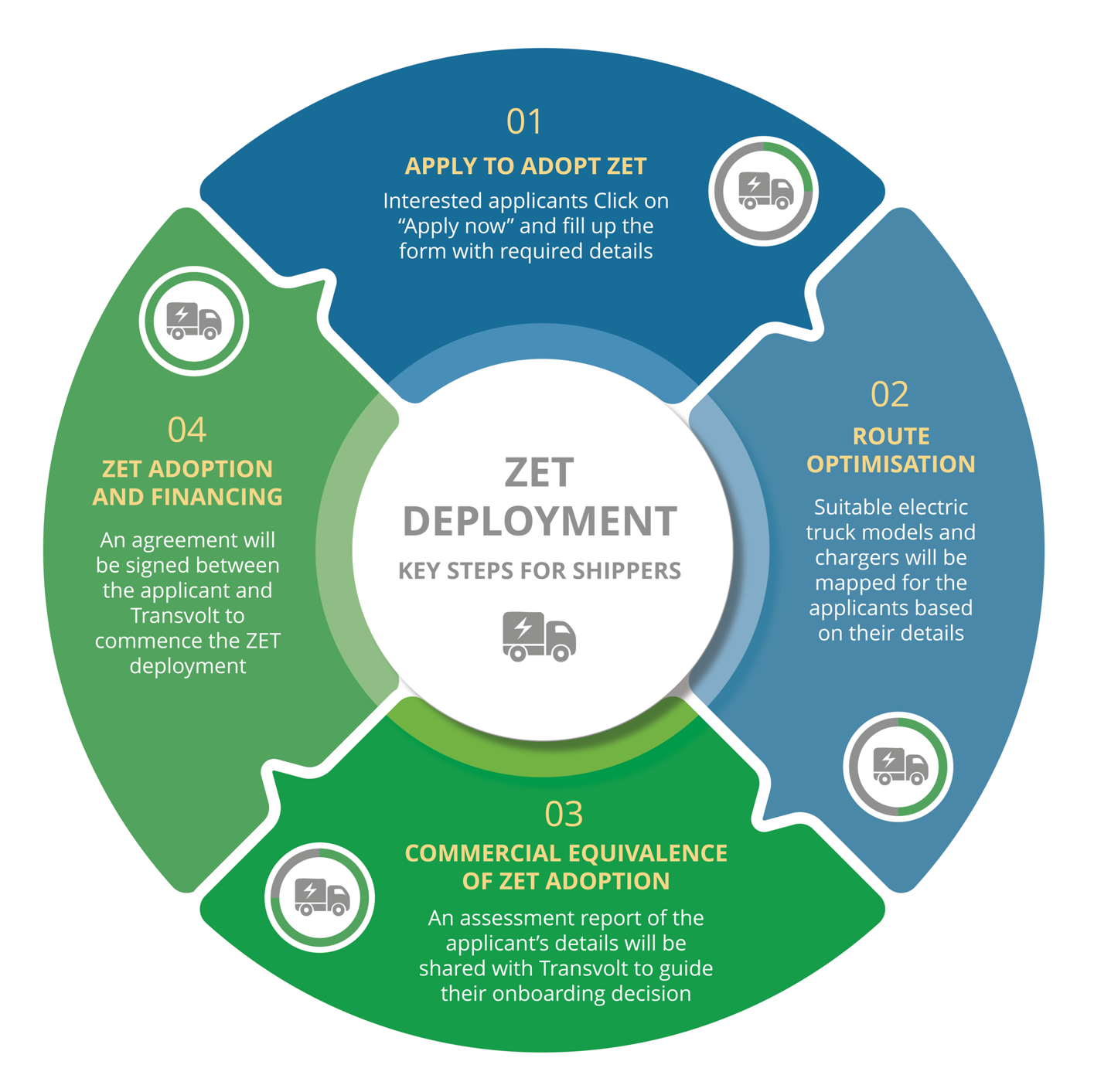
The process for on-boarding applicants and deployment of ZETs in their delivery chain has been illustrated below in 4 key steps. The 4 key steps are as follows:
Step 1
Apply to adopt
The applicants who want to deploy ZETs in their delivery chain need to apply by clicking on “Apply now”. They need to enter basic details about their company (like name, company profile, contact details, among others) and then click on “Fill up the form” to fill the questionnaire with information about their delivery needs, operations, existing fleet size and models, business details, fueling needs, etc. The details will be collected on the basis of route, where for each route a unique ID will be assigned and a new form has to be filled. Read More Applicants interested in deploying ZETs in their delivery chain may begin by clicking on “Apply now.” They will be asked to provide basic information about their company, including the company name, profile, contact details, business domain, website, and other relevant particulars. After submitting these initial details, they can proceed by selecting “Fill up the form” to complete a detailed questionnaire covering their delivery routes and requirements, trip and operational patterns, existing fleet size and vehicle models, business information, fueling needs, and other operational aspects. The details will be collected on the basis of route, where for each route a unique ID will be assigned and a new form has to be filled. During the analysis, additional information may be requested as needed, and our team may conduct site visits to the applicant’s hubs or key locations to better understand their operations and gather operational insights. Step 1 is non-chargeable, and the information collected at this stage will form the basis for analysis and decision-making in the subsequent steps.
Step 2
Route optimisation
On the basis of the information filled up by the applicant, ZET models will be shortlisted from the eligible OEMs according to the operations and needs of the applicant. Further, suitable chargers will be mapped for the ZETs for ensuring smooth operation of the ZETs. Read More On the basis of the information filled up by the applicant, ZET models will be shortlisted from the eligible OEMs according to the operations and needs of the applicant. Further, suitable chargers will be mapped for the ZETs for ensuring smooth operation of the ZETs. There will be monitoring of vehicle and trip related data including trip frequency, trip length, vehicle range, fueling needs, trip routes, delivery and resting points, among others for a span of 21 to 30 days. Based on the data collected, delivery route will be optimized for the applicant through technical analysis of the routes and delivery patterns. The findings of analysis will lead to shortlisting suitable vehicles and chargers for the applicant. This process shall be chargeable to the applicant. The outcome of the analysis will be shared as a summary with the applicant, A detailed analysis will be shared with Transvolt to aid in their decision-making process.
Step 3
Commercial equivalence of ZET adoption
The analysis report shared with Transvolt covering route characteristics, and vehicle and charger mapping will support Transvolt’s decision-making in this step. The commercial equivalence of adopting ZETs will be evaluated against existing ICE operations to assess the financial implications of transitioning to ZETs. The outcome shall be communicated to the applicant post an apple-to-apple financial comparison of ZET operations to existing ICE operations. Read More The analysis report shared with Transvolt covering route characteristics, and vehicle and charger mapping will support Transvolt’s decision-making in this step. The commercial equivalence of adopting ZETs will be evaluated against existing ICE operations to assess the financial implications of transitioning to ZETs. Using data on trip routes, delivery operations, trip frequency, fueling needs, and the costs of shortlisted vehicles and chargers, an apple-to-apple financial comparison will be undertaken between current ICE operations and the proposed ZET deployment to determine commercial viability. If the overall cost of operating ZETs is found to be lower than that of ICEs, a positive deployment decision may be made. The results of the commercial equivalence assessment will be communicated to the applicant, enabling them to move forward with the deployment phase based on the financial impact of ZET adoption on their business.
Step 4
ZET deployment and financing
Followed by the decision of Transvolt and the applicant based on the commercial equivalence, agreement will be signed between the applicant and Transvolt for deployment of ZETs in the selected routes. In parallel, the financing team will assess and select the most suitable financing mechanism for the deployment—this may include blended finance, direct credit, or any other feasible option. At the end of this step, the order shall be placed for the identified vehicles and infrastructure procurement process shall be started for the identified chargers. Read More Followed by the decision of Transvolt and the applicant based on the commercial equivalence, agreement will be signed between the applicant and Transvolt for deployment of ZETs in the selected routes. In parallel, the financing team will assess and select the most suitable financing mechanism for the deployment—this may include blended finance, direct credit, or any other feasible option. During this stage, the ownership model and overall financing structure will also be developed to clearly outline the credit flow, applicable interest rates, loan duration, and other relevant financial parameters. Upon finalising these arrangements, the order for the identified vehicles will be placed, and the procurement process for the required charging infrastructure will begin. The successful completion of this step will be indicated by the issuance of the vehicle purchase order and the initiation of withdrawals from the ESCROW account for infrastructure procurement.