

about nhev
About the NHEV Pilot Project
About Piloting Agency - EoDB Services
EoDB is a Special Purpose Entity (SPE); currently India’s premier emerging Tech-Piloting agency, privately held and registered in New Delhi ROC, contributing nationwide with its pilot projects in micro-level tech-economies in new markets across states and sectors in the macro tech-o-nomic Bharat vision of PM Modi.
EoDB extend ‘Ease of Doing Business’ reforms through evidence-based tech pilot programs with private sector participants since 2014 by testing, prototyping, piloting, validating, establishing and commercializing their tech aligned to national ambitions. This SPV exclusively contributing to our Prime Minister vision and national ambition of tech adoption in economy by going on ground to do real-world pilots beyond bureaucratic boundaries and obligations to deliver actual Ease of Doing Business and lay a red carpet on grassroots levels for commercialization of emerging technologies through full-scale ecosystem pilots.
Miniature Concept Model of NHEV
This Ease of Doing Business, 3G Energy Station infra in a miniature concept model charging station was revealed by Union Minister for Road Transport and Highways, Government of India Shri Nitin Gadkari in Sept 2022. This 3rd Generation National Highways for Electric Vehicles (NHEV) world-class charging station miniature of upcoming charging stations on Agra-Delhi-Jaipur routes is expected to support India’s first 500 km e-highway in its 3rd generation pilot phase during 3rd Technical Trial of 2024. The pilot is aimed at upgrading 5000 km of routine highways into E-Highways from 2026 with these futuristic charging stations equipped with advanced technology of connected vehicle, multi-modal connectivity, state-of-the-art hospitality services, logistics hubs, and heavy duty truck charging infra, battery-swapping facilities for local e-mobility. Exhibited 3rd generation of futuristic ‘Petrol Pumps’ with prefabricated steel structure and geopolymer concrete infra, early CapEx breakeven to hold hub and spoke model for employment, economy and environment; building ‘Circular Economy’ around the stations in the rural circumference.


NHEV 3G Energy Station
NHEV is starting with 40+ chargers on these 3G energy stations with clarity that these 3.2 MW energy stations are the future of decarbonized mobility ultimately going to move completely on renewable energy, facilitating passenger and freight mobility on Indian e-highways without any fossil fuel, thermal grid carbon emission or energy import for mobility.
- 800 KWH Compact Substation on Thermal Grid only for a period of 5 years from commissioning.
- 800 KWH Solar Compact Substation with battery storage to optimize dispense renewable energy.
- 800 KWH Green Energy dispensing to be prototyped from vertical wind turbines on road separators.
- 800 KWH Green H2 from micro electrolyzer powered by surplus Solar & Wind renewable energy.
National Rollout Of 5500 km E-Highways : Bharatmala & Sagarmala
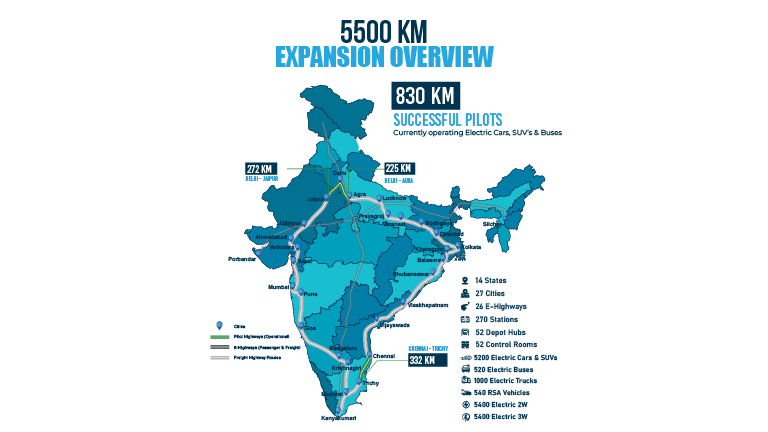
After successfully piloting hybrid PPP model “Annuity Hybrid E-Mobility (AHEM)” to commercially prototype movable assets EVs, E-Bus, E-Trucks, Chargers, Road Side Assistant (RSA), On-Road Services (ORS) in 3 impactful technical trials on Delhi-Agra (Yamuna Expressway – 2020) and Delhi – Jaipur (NH48 – 2022), Chennai – Trichy (NH 179 – 2024). NHEV stands as a profitable pilot project to enter into infra from 2026 after revealing 3rd Gen NHEV 3G Energy station in 2024 to be fully prototyped by 2026 in Public-Private Partnership (PPP) mode by the agency EoDB Services Pvt Ltd (SPE) NHEV previous industry participated, sponsored, and highly appreciated pilots stands as a testament for agency to secure Rs. 3672 Crore INR Credit Outlay Funding from a private bank HDFC. Going forward the pilot shall start commencement of 270 3G Energy station is cover 5500 km route across India from 2026.
Explore Station Allocation Across All Zones
Pilot States
Ev Buses
RSA Vehicles
EV 2W
Battery Swapping
Stations
Digital Billboards
Highways
Advertisement Hoardings
Infotainment ScreenS
EV Cars
EV 3W
PPP Model Annuity Hybrid E-Mobility (AHEM)
AHEM draws from proven financial model precedents from HAM (Hybrid Annuity Model) launched in 2016. It is inspired by the HAM model of Shri Nitin Gadkari Ji, introduction of which in 2015 quadrupled the speed of road construction. Previously in HAM Govt/NHAI pays 40% of the total project expenditure in 10 equal installments on milestones the remaining 60% is raised through annuity payments, split between 30% road developer and 30% is raised as debt from banks. The government remains responsible for toll collection. The government selects the concessionaire of the project. The Life Cycle Cost is the parameter for bidding. The concession period includes the construction period and 15 years of fixed operations. The concessionaire is responsible for maintaining the project till the concession period comes to an end.

AHEM is derivative of HAM and it is a PPP model principally inspired by where assets typically stations are allocated for CapEx in split of 30% to Public Sector, 30% to Private Sectors and 30% to People (individual or group) rest 10% assets such as charging depot hubs, control rooms remains with e-highway state operators. Initial construction of charging infra is backed by Private & Public sectors banks for a moratorium period of 12 months on the basis of allocation affirmation or LC. Land acquisition for station is done on hybrid mode by using NHAI land parcels for wayside amenities and direct purchase both. Repayments are assured in advance on predetermined annuity by monetization of assets and space at stations for various e-mobility and auxiliary activities, like- advertising, roadside assistance, food court, bank – ATM, conference and outlets.
To fast-track highway building, the government brought HAM model and aimed to award projects worth more than Rs 40,000 crore on the new hybrid model by March. Within 36 months of introduction of HAM Out of 123 HAM projects awarded, some 121 projects were sanctioned till 2019. Majority of projects were funded by the private banks including NBCC out of all awarded 101 projects have achieved financial closure till 2019. By the end of year Govt of India approved the hybrid annuity model (HAM) for building National Highways (NH) to speed up the construction of roads in the country by renewing interest of private developers in highway projects and to tap the benefit of long term funds like pension fund, insurance fund, wealth fund etc into road construction sector, MoRTH had introduced models like HAM and TOT (Toll-Operate-Transfer).

Consideration from Ministry of Road Transport & Highway
According to recent answer from Govt of India through Ministry of Road Transport & Highway in Lok Sabha on 10th August 2023 Q No 3536 Ministry stated that the proposal to notify AHEM has not yet been taken into consideration to introduce a new Annuity Hybrid E-Mobility (AHEM) model instead of existing Hybrid Annuity Model (HAM) to upgrade existing highways into e-highways.
Evidence Based & Data Driven Model & Methodology
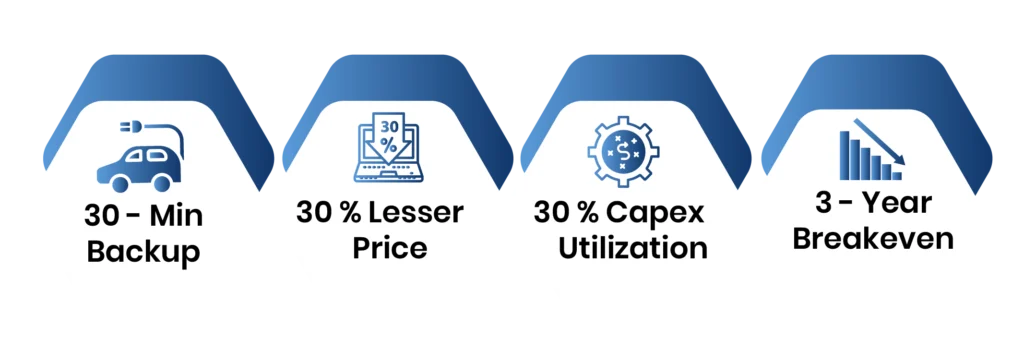
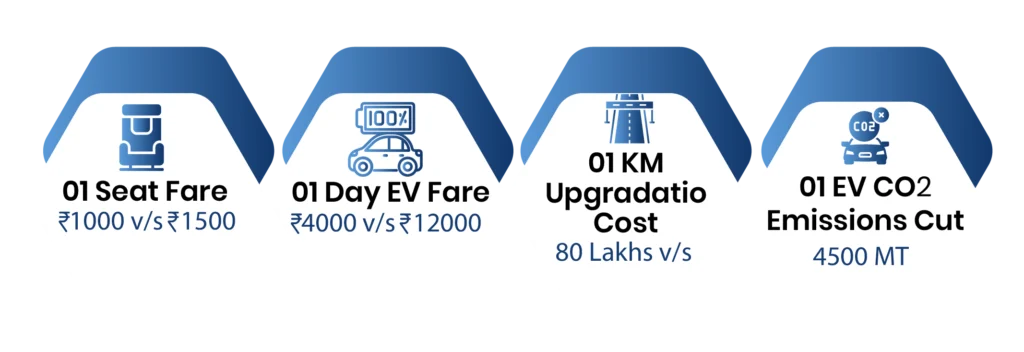
NHEV has now given evidence-based content to this noble intent of NITI Aayog and MoRTH to be applied on e4W where fleet operators are now able to buy EV Cars, Buses and SUVs on a 30% reduced upfront cost, with a battery fitted but owned by a BaaS operator who periodically raises a monthly bill to the fleet owner covering vehicle charging, RSA and a maintenance premium in a post-paid bill format according to their actual fleet usages. It is a game changing pilot successfully resolving the high upfront cost of electric SUVs and buses by motivating Banks, NBFCs and Investors to finance this national transition and adoption.
The main working methodology of EoDB pilot project- National Highways for Electric Vehicles, is to upgrade existing connecting National Highways and Expressways between start and end cities into E-highways. Deep analysis on current traffic of Fleet, passenger and freight has been done and based on that Average numbers have been curated that is feasible in today’s business scenario. Based on these numbers and Technical Trials, the number of stations gets calculated alongside their designing, capabilities and positioning and they’re allotted to respective CapEx allottees and investors on AHEM.
Decarbonisation of Station Power Source from RE

NHEV Reform Based Methodology on MoP Guidelines
Funding from Climate Financing
NHEV is one of the largest evidence-based policy-making pilot projects that brings substantial private capital inflow of INR ₹3672 Crore for massive upgrade of 5500 km highways into e-highways on sturdily built Annuity Hybrid E-Mobility (AHEM) charging infra funding model. This monumental Ease of Doing Business pilot paves the way for some crucial technical advancements like Centralised EV Registration System (EVRS), Advanced Roadside Assistance (RSA), Anti Theft EV Ecosystem, e4W Relay Model Resilience, V2G Bidirectional Competence, Battery-as-a-Subscription (BaaS Model), Battery Swapping Kiosks, Battery Recycling Lifecycle, Green Energy Open Access, Renewable Purchase Obligation (RPO) for Charging Stations through Green Open Access Registry (GOAR).
Current Status of NHEV Project
NHEV has entered its construction and allocation phase after securing ₹3,672 crore in funding and securing the credit outlay required for the construction phase in January 2024. Followed by opening threads of conversations with Power & Petroleum PSUs to collect their affirmation and letter of confirmation to own 30% approximate 40 charging stations once construction is completed from bank credit outlay and they are ready for handover with 30% minimum guaranteed utilisation contracts and revenue from monetisation of various other assets at station.


NHEV 5500 km National Rollout target accomplishment preponed to 2027
Aligned with the government’s infrastructure vision, “NHEV is set to achieve the 5,500 km e-highway target across 27 cities by 2027, ensuring faster EV adoption and seamless green mobility across the nation”, announced Mr. Abhijeet Sinha, Pilot Program Director-NHEV.
Complementing the Finance Minister’s PPP agenda, he states, “The third-generation ‘green fuel charging stations’, to be set up on a 5,500 km stretch across 27 cities, will be a game changer as they will have hydrogen dispensing capabilities, apart from grid, solar and wind power”. Mr. Sinha emphasized that these green fuel charging stations will be established under the Bharatmala and Sagarmala routes in tune with Prime Minister Narendra Modi’s vision to achieve net-zero carbon emissions by 2070.
Budget 2026-27: Strengthening Infrastructure Growth through PPP-led Development like NHEV
Budget 2025-26: Big push for large infrastructure projects like NHEV
Hon’ble Finance Minister Smt. Nirmala Sitharaman Ji reiterated the Government’s commitment to infrastructure-led growth in the Union Budget 2026-27, with continued emphasis on capital expenditure, public-private partnerships (PPPs), and investment-driven development. The Government has increased capital expenditure to ₹12.2 lakh crore, reinforcing its vision of building world-class infrastructure across transportation, logistics, urban development, and energy sectors.
This renewed focus on PPPs aligns with India’s ambitious goal of accelerating economic growth while ensuring efficient project execution and long-term sustainability. By encouraging private sector participation, innovation, and investment, the Government aims to fast-track the development of critical infrastructure, improve operational efficiency, and maximize economic impact. Such policy support creates a favourable ecosystem for transformative initiatives like NHEV, which leverage collaborative financing and advanced technologies to develop next-generation mobility and energy infrastructure across the country.
Hon’ble Finance Minister, Smt. Nirmala Sitharaman Ji announced a renewed push for private sector participation in large infrastructure projects. Each infrastructure-related ministry will create a 3-year project pipeline for Public-Private Partnerships, making it a catalyst for infrastructure development. An Urban Challenge Fund of Rs 1.5 lakh crore will also be set up to finance projects, with private sector support being encouraged through various initiatives and support schemes.
This emphasis on PPPs aligns with the country’s ambitious targets of strengthening its economic infrastructure and achieving significant growth. By leveraging private sector innovation, investment, and expertise, the government aims to accelerate the completion of vital projects, streamline operations, and optimize resources for maximum impact.
Accelerate India's EV Revolution with NHEV
Join the movement shaping the future of electric mobility. Be part of this groundbreaking initiative, for innovative collaborations, and sustainable development.
